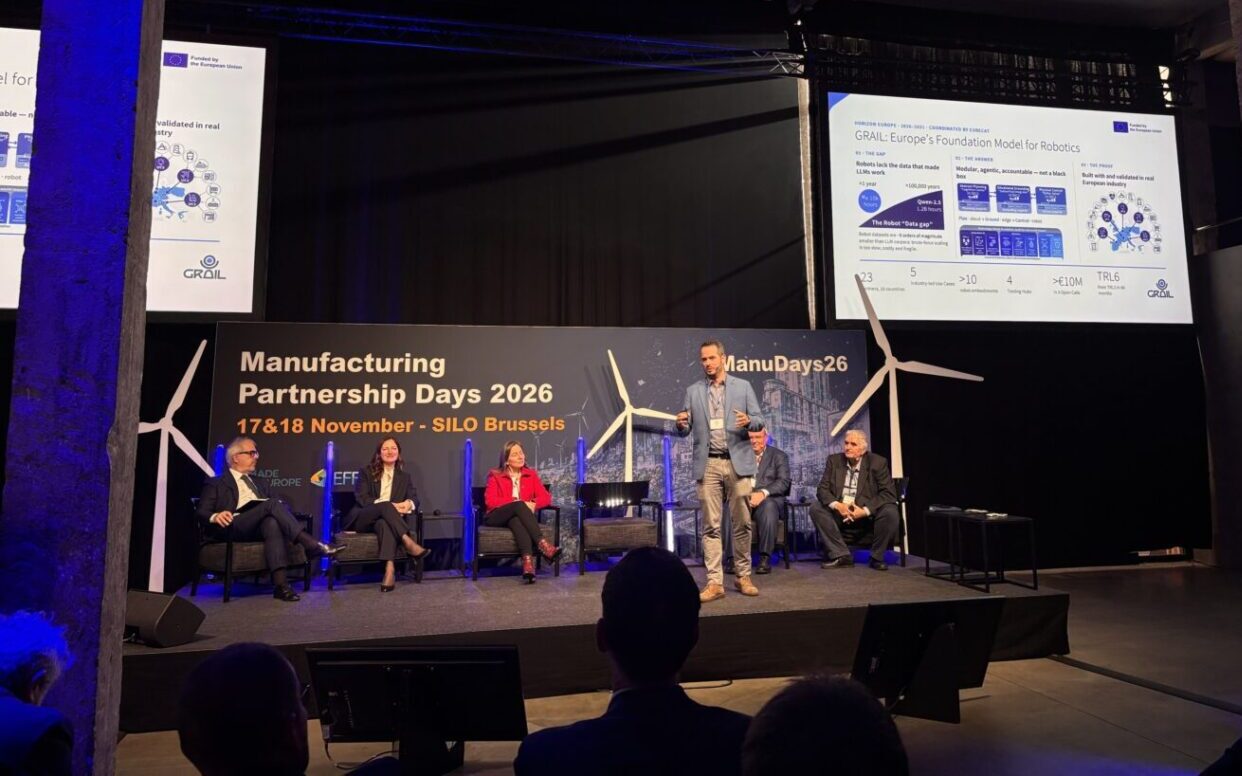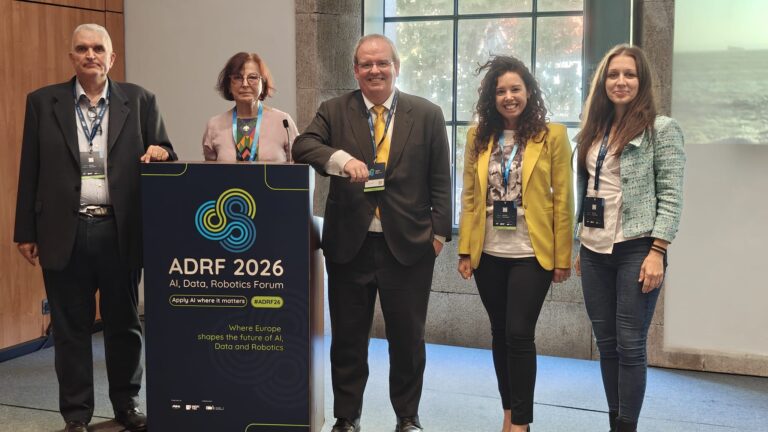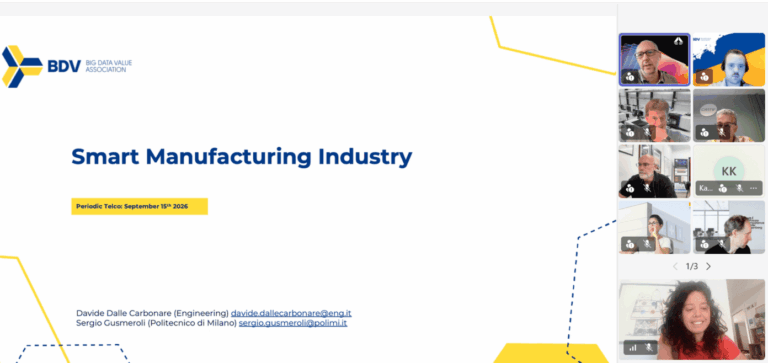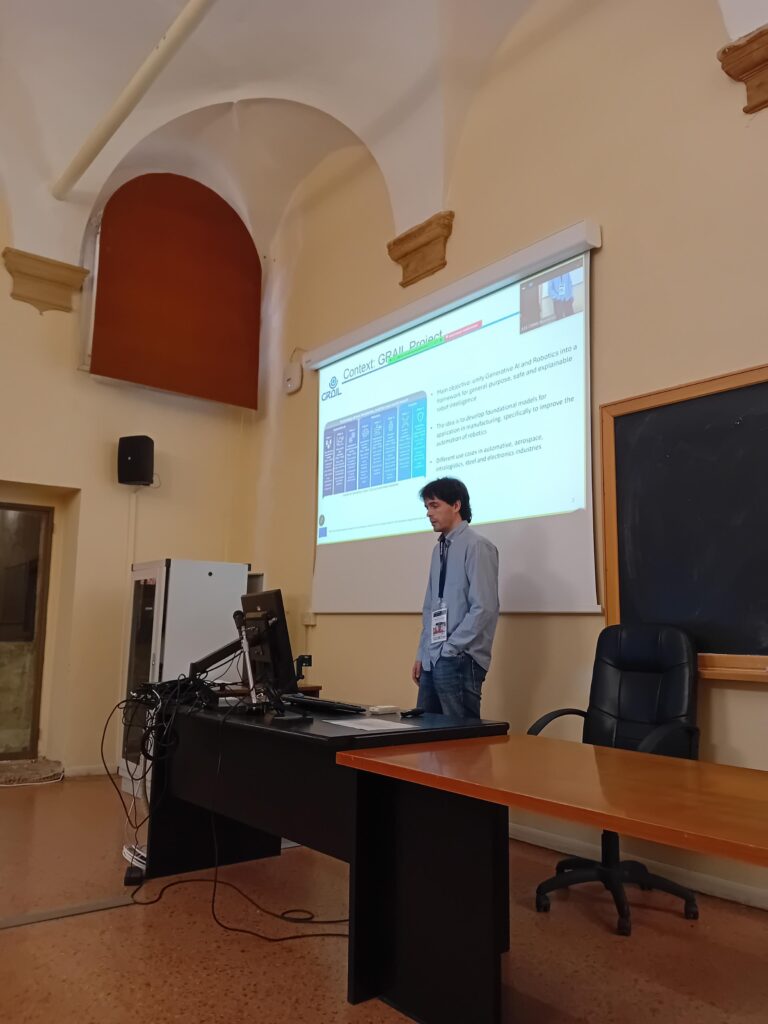
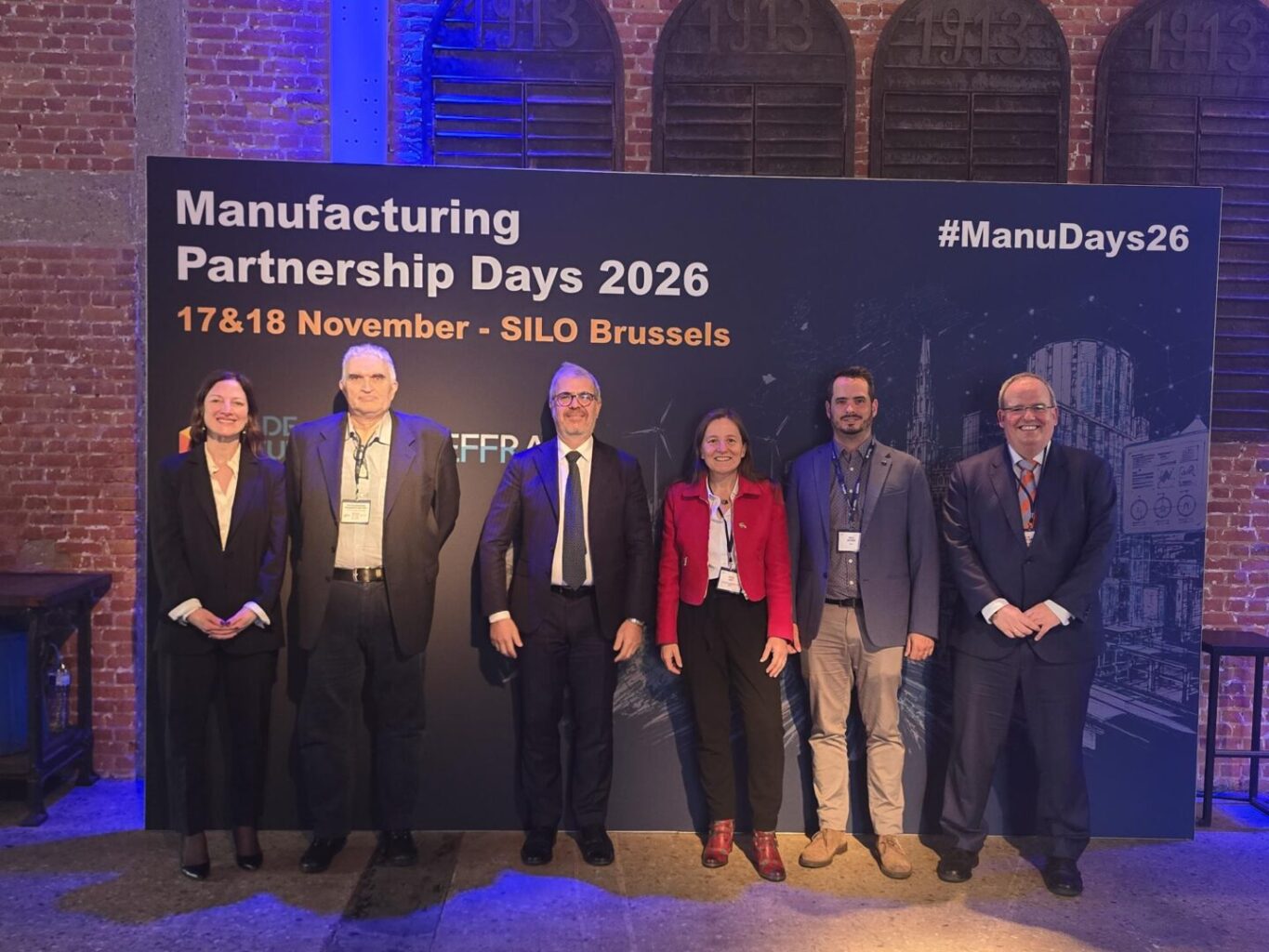
The event brought together industry leaders, research organisations and European institutions to discuss the transformation of European manufacturing and the role of emerging technologies in strengthening industrial competitiveness.
Magí Dalmau, co-coordinator of GRAIL, joined the panel discussion “GenAI in Manufacturing”, alongside Cécilie Huet, Head of the Robotics and Artificial Intelligence Unit at the European Commission; Emanuela Girardi, President of ADRA; Marco Taisch, representing EFFRA; and Óscar Lázaro, coordinator of the euroFMX project. The discussion was moderated by Sergio Gusmeroli from Politecnico di Milano, also a coordinator of euroFMX.
The panel explored how Generative AI can transform industrial processes and what Europe needs to accelerate its adoption in manufacturing.
During the discussion, GRAIL highlighted the need for a robotics-specific approach to scaling Physical AI in Europe. Unlike language models, robotics foundation models must account for physical interactions, control, safety and the complexity of real-world environments. Robotics data, including information on forces, contact and system states, is costly to collect and often highly dependent on specific robotic platforms.
Another key message was that the success of Physical AI must be measured by its operational impact in factories. Beyond technological demonstrations, AI-powered robotic systems need to solve real industrial challenges, integrate into existing production processes and deliver measurable value. Real-world validation, functional qualification and certification will therefore be essential to move from isolated pilots to scalable industrial deployments.
The discussion also addressed the human dimension of Physical AI adoption. Deploying more intelligent robots requires rethinking industrial processes and workforce capabilities, enabling operators to supervise, teach and continuously improve robotic systems in safe and collaborative environments.
These priorities are closely aligned with GRAIL’s ambition to develop a European general-purpose foundation model for robotics, enabling robots to learn, adapt and perform across different industrial tasks and environments.
The event also provided an opportunity to introduce the GRAIL Genesis Open Call, which offers a total of €1 million in funding, with up to €100,000 per project, to support the development of robotics datasets, data-collection technologies and benchmarking tools. Applications are open until 10 February 2027 at 17:00 CET.